
Jean | 1960
The Recipe We Called Love

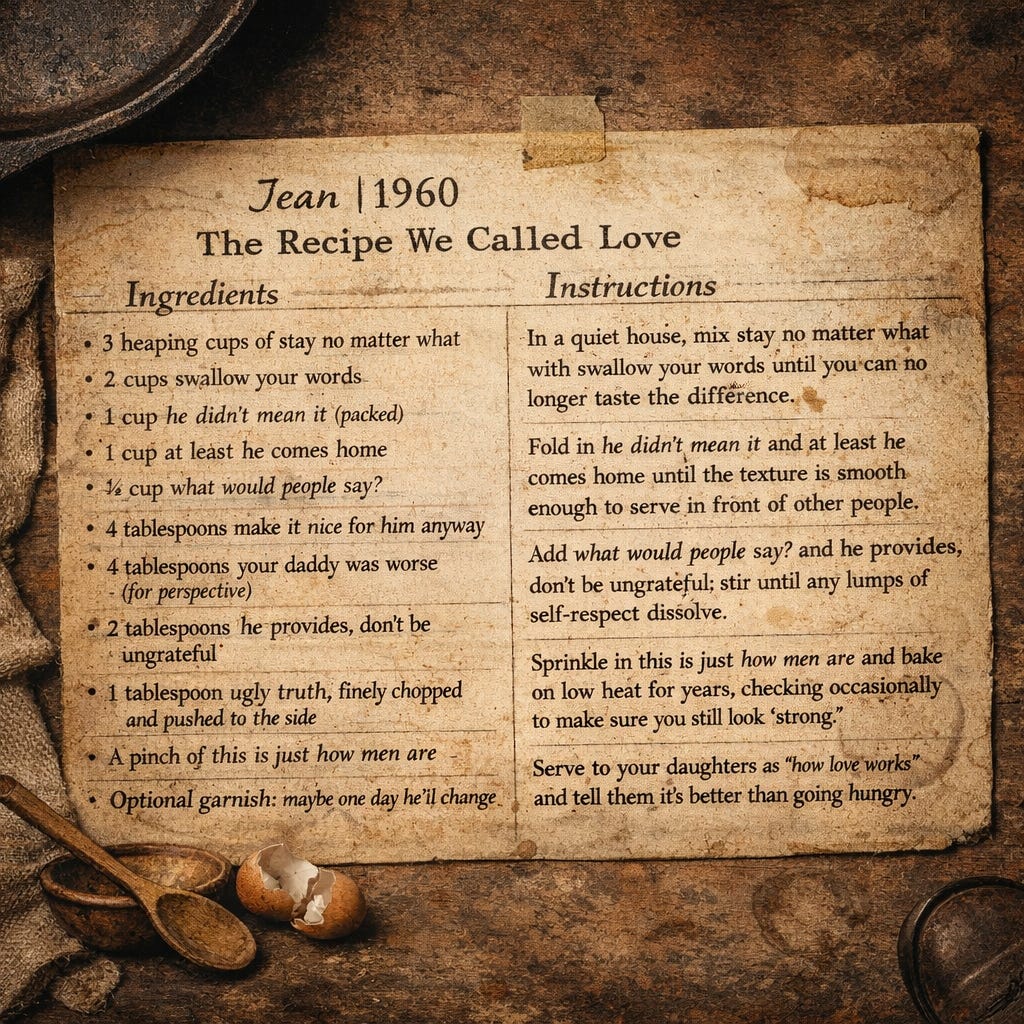
By four o’clock, the house was holding its breath.
The sun had baked the dirt road out front into hard cracks, and the cicadas were loud enough to drown out the radio. Inside, the air was thick with frying okra and lye soap, two scents that had come to mean “home” whether Jean liked it or not.
She stood at the washbasin on the back porch, sleeves rolled, hands deep in gray water. George’s work shirts, Henry’s trousers, one of Birdie’s housedresses waited beside the tin tub. The washboard leaned against the wall, still dry.
“You gon’ rub the color clean out them things, you keep on worryin’ that hem like that.”
Birdie’s voice drifted through the screen door, flat and sharp. Jean paused, knuckles pressing into the wet cotton. Through the mesh she saw Birdie’s wide back moving between stove and oven.
“I’m gettin’ it,” Jean said quietly. “Just takin’ my time with it is all.”
“Mhm.” More judgment than agreement. “A washboard ain’t there for decoration, Jean. Folks see you standin’ out here finger-scrubbin’ like a field hand, they gon’ think we don’t know no better.”
Where she came from, a washboard was something you saw at other folks’ houses, in big yards with straight clotheslines. At Francis’s place, you knelt beside a washtub and used what God gave you—wrists, fingers, a flat rock if you were lucky. A washboard would’ve been a blessing, not a choice.
She dipped the shirt back into the water instead of saying that. Birdie liked her words neat and ironed; Jean’s always seemed to come out wrinkled.
“Bring them things in before they sour,” Birdie called. “George gon’ be home soon. Supper best be ready and that wash best done by then.”
George gon’ be home soon.
The words still sent a flutter through Jean’s chest, even when she didn’t want them to. She thought of his easy smile, how he wore his hat tipped just so, how he walked into a room like nothing on Earth could touch him. The fact that half the women in Aliceville watched him the same way she used to did not escape her, though she pretended it did.
He saved you, Francis’s voice whispered from somewhere behind her ribs. You don’t forget that, Jean.
She had been seventeen when Francis sat her on the edge of the sagging bed.
“What about what I want, Mama?” she’d said, cheeks wet. “I love Bernard, not George.”
Francis had laughed without humor, eyes sweeping the crowded room where fourteen bodies slept in shifts. Rain slipped through the roof into chipped bowls and one rusty pot.
“What you talkin’ is foolish,” Francis said. “You think it’s love? Look around, baby. This what love gets you.”
Her arm had swept across the shack like a verdict.
“I see so much of me in you, girl,” she’d said, softer. “I don’t want you to end up like this, Jean. George ask for you, you go. You don’t throw away a way out ‘cause your heart feel fluttery over some boy ain’t got two nickels.”
So Jean went. George’s folks had a proper house. There was food. The roof didn’t leak. For a while, she thought maybe Francis was right, until the flutter in her chest hardened into something else.
Security. Fear. Debt.
“Jean!” Birdie’s voice snapped her back. “You hear me?”
“Yes ma’am.” She wrung out the last shirt, hung it over the line, then carried the empty basin inside.
The kitchen was hot as open breath, the windows cracked but no air moving. Birdie stood at the stove, stirring the cast-iron skillet, okra popping in the grease. Her housedress clung to her back, dark with sweat.
At the small table by the window, Henry sat with his stump propped on a chair, the empty leg of his trousers pinned. His other foot tapped the floor in a steady, irritated rhythm. A half-empty bottle of corn liquor sweated little rings onto the table.
He was a big man gone slightly slack, his frame still carrying the echo of the strength he once had. Losing a foot to the sugar had taken more than flesh. It had taken his pride and whatever patience he’d had for the world.
“You puttin’ too much salt in that,” he grumbled, watching Birdie’s hand. “Ain’t tryna die twice, woman.”
“You ain’t gon’ die from okra,” Birdie said, not turning. “You die, it’s gon’ be ‘cause you drinkin’ yourself to it.”
He snorted. “That right? You a doctor now?”
“Somebody gotta pay attention to your fool self,” she said. “We already paid the first time.”
Jean set the basin by the door and reached for plates. Birdie and Henry had been stepping on each other’s toes for decades. Their rhythm was older than she was.
“Don’t start that cryin’ ‘bout what you done,” Henry said, lifting the bottle. “That was the Lord’s doing. I walked ‘cause I was a man, not ‘cause you stirred some pot.”
Birdie’s shoulders tightened. She flipped the okra with a stiff wrist.
“You walk ‘cause I prayed over your fool self, night and day,” she said, voice low. “You came home ‘cause I stayed. You eat ‘cause I keep cookin’, even when you too proud to say thank you.”
He laughed, mean and short.
“Ain’t nobody thankin’ you, Birdie,” he said. “Look at you. Ain’t nobody want your kinda ugly. And even I wonder, some days.”
Jean’s hands stopped. She waited for Birdie to shoot back. Instead, Birdie just pursed her lips, the only sign she’d heard him.
The quiet was worse than the arguing.
Outside, a car rolled by slow, gravel crunching. Somewhere nearby a baby cried, then was quickly shushed. It felt like the whole world was leaning toward that kitchen. Jean’s breathing softened without her even meaning to; she didn’t want to exist in the space between their words.
Birdie took the skillet off the stove, oil still hissing, and spooned okra onto a plate. Henry shifted, foot tapping faster.
“You lucky I kept you,” he muttered. “Ugly as you is, ain’t nobody else woulda done it. Should be thankin’ me.”
The words dropped heavy.
Jean felt them like a slap, even though they weren’t meant for her. Birdie’s head dipped almost imperceptibly, not a nod nor agreement, just the flinch of someone who’d had a lifetime of such blows.
She set the plate in front of Henry without looking at him.
“You eat,” she said. “Food gettin’ cold. I ain’t heatin’ it twice.”
He stared at the okra, then at her face. Something hot and sour twisted his features.
“You hard-headed as ever,” he said. “Can’t even take a joke.”
He reached for his left shoe—the one he didn’t need anymore. It sat under the table, still polished from the days he wore it to church.
“Henry…” Birdie said, warning in his name.
Before Jean could move, he hurled the shoe across the room.
It struck Birdie on the side of the head with a dull thud, knocking her forward. The plate rocked, then tipped, okra tumbled across the table, chair, floor. A few pieces skittered under the stove, leaving little trails of grease.
For a heartbeat, no one moved.
Jean stepped forward, hand half-raised, but Birdie straightened too fast for help, palm pressed to the spot where the shoe had hit. Her lips were a thin line, her eyes bright but dry.
Henry leaned back, satisfied.
“You best have that cleaned up ‘fore I get back,” he said, as if he’d only pushed a plate too hard. “I don’t wanna see a speck on this floor when I get back. Ya hear?”
He grabbed the bottle and hauled himself up, giving Birdie a cold stare as he reached for his walking stick. With one hard stomp of his good foot, Henry turned toward the hallway, leaving resentment and silence trailing behind him. A faint mutter about ungrateful women followed him out before anyone in the kitchen let themselves exhale.
The screen door creaked, slammed. Silence settled like dust.
Grease pooled beneath the table. A piece of okra clung to the leg of Birdie’s chair. The smell—earthy, fried, familiar—suddenly made Jean’s stomach turn.
She bent for a dishcloth. Birdie’s hand flashed out, catching her wrist.
“What you think you know, girl?” Birdie snapped, voice hoarse. “You don’t know nothin’.”
The sting of it cut deeper than the shoe.
For three years, Jean had bent herself into shapes trying to fit this house. Sat on her words. Smiled when church ladies whispered about George’s “friendly ways.” Learned how to season food like Birdie, starch George’s collars like his mama, swallow humiliation when he walked in smelling like someone else’s perfume.
Still, she was always the girl who didn’t know nothin’.
She pulled her wrist free.
Something in her uncurled, slow and deliberate, like a fist opening.
“I know some things,” she said, voice quiet but steady.
Birdie huffed, turning back toward the counter. “You don’t know what it is to—”
“I know how to stitch up gashes as wide as my thumb,” Jean said, louder now. “I know how to hold a rag to my mama’s face while the blood runs down my arms.”
Birdie’s back stiffened.
“I know how to water down my daddy’s hooch when he ain’t lookin’, so maybe he don’t get so mean and break her nose again,” Jean went on. “I know how to wash clothes in a cracked tub with no board at all. Hands raw, water cold, soap half gone, and still make ‘em clean enough so the neighbor ladies don’t talk too loud.”
Slowly, Birdie faced her.
For the first time, Jean didn’t look away. Her chest felt like it might crack open, but she held Birdie’s gaze with something new and unyielding.
“And I know,” she said, softer but sharper, “that your son loves me just as much as his daddy loves you.”
There it was—the nastiest truth she owned, laid out on the kitchen floor with the scattered okra.
Not the sweet kind of love the preachers hollered about. The other kind. Bound up with need and pride and fear, with staying because you don’t see another way out, with hurting the person closest to you because they’re the one who’s not allowed to leave.
Birdie’s mouth opened, then closed. Fury, hurt, recognition battled under her features. For a second Jean thought she might slap her. She braced for it.
Instead, Birdie sank into the nearest chair.
Her hand found the back of her head where the shoe had hit. Her fingers came away clean. She stared at her palm like she’d expected red.
“You don’t talk to me ‘bout my husband,” she said, but there was no heat in it now. Just the weary rasp of someone who’d run out of fight.
Jean’s throat burned. She wanted to pull the words back, but some small, stubborn part of her refused.
Birdie’s gaze lifted again, softer now, and for the first time Jean saw something in it that looked almost like… fear.
“You think that’s love?” Birdie asked quietly. “What you just said?”
The question hung between them, heavy as August air.
Jean thought of Francis, of that crowded shack and the way her mama had looked at her with envy and pity when George asked for her hand. She thought of Bernard’s easy laugh, the way his hand had felt in hers, the way she’d watched his back as he walked down the dirt road because Francis had told her to let him go.
She thought of George’s cologne and lipstick on his collar, the way he walked into rooms like the world was waiting. The way her stomach still flipped when he smiled at her like she was the only one there, even when she knew she wasn’t.
“I think…” Jean started, then stopped. The truth tasted bitter.
Her eyes dropped to the mess on the floor. Okra, flour, grease. A meal wasted for no reason but a man’s pride.
“I think it’s what we keep callin’ love,” she said at last. “Whether it is or it ain’t.”
Birdie let out a long breath, almost a sigh.
Outside, Henry laughed at something on the porch, the sound sharp and humorless. A car horn honked in the distance. The world kept on.
“Get a rag,” Birdie said finally, nodding toward the spilled food. “Before this grease set. Floor gon’ be slick as sin.”
No apology. No sudden tenderness. But the words didn’t cut.
Jean grabbed the cloth and knelt, wiping carefully, scooping ruined okra into her hand. Birdie watched for a moment, then bent with a small grunt and joined in.
They worked in silence, side by side, two women on their knees cleaning up after a man’s tantrum. But the quiet between them had changed shape. It held something shared, fragile, not yet nameable.
When the last smear of grease was gone, Birdie sat back on her heels and sighed.
“You mama,” she said slowly, eyes on the clean floor, “she teach you that? Those… things you know?”
Jean thought of Francis, and the bitter way she’d said this what love gets you as she straightened Jean’s collar before sending her off with George.
“She taught me what not to want,” Jean said. “Best she could.”
Birdie nodded to herself.
“My mama taught me to stay,” she said. “Said a man that go out and come home is better than one that just go.”
She let out a dry chuckle.
“Never did say what to do when he come home mean.”
Jean looked at her—at the faint bruise near Birdie’s temple, the set of her mouth, the years of staying carved into her face.
“I’m sorry he threw that shoe at you,” Jean said quietly.
Birdie waved a hand.
“He ain’t throw it at me,” she said, though they both knew he had. “He throw it at the world and I got in the way. That’s how men… like Henry love. They mad at life, so they aim at what’s close.”
She rubbed her temple, then glanced at Jean with something like respect.
“You ain’t wrong ‘bout George,” she said. “He love you, not the same as his daddy. But not any different either. Lord help you.”
Jean’s chest tightened.
She didn’t see the future as some straight, bright line anymore, but a knotted thread looping back on itself. Birdie enduring Henry. Francis enduring her husband. Jean enduring George. Then the next girl, and the next, each handed the same recipe. The same heaping pot of bitter stew, served up as love because nobody had ever given them anything else to call it.
Children, not yet born, learning to watch their mothers swallow their feelings like medicine and call it strength.
“I don’t want it to be the same for my girl,” Jean heard herself say.
The words surprised her. She didn’t even have a daughter yet, just a vague ache in her belly that hoped to be filled someday. Still, the statement sat in the room like a promise.
Birdie’s eyes softened, just a fraction.
“Then you gon’ have to learn her different,” she said. “And you gon’ have to learn you different first.”
The idea seemed as impossible as pulling a new road out of the dirt with bare hands. But hearing it from Birdie—who had survived Henry’s meanness and her own mother’s lessons and still kept the house standing—made it feel less like fantasy and more like a dare.
George’s footsteps sounded on the front steps, the scrape of his boots, his whistle off-key but confident. The familiar flutter stirred again in Jean’s chest, this time mixed with something else. Not quite hope. Not quite defiance. Just… awareness.
Birdie pushed herself up, joints popping.
“Get up, girl,” she said. “Wash your face. Ain’t no man worth seein’ you look shook.”
Jean stood, wiping her palms on her skirt. At the doorway, she paused and glanced back.
Birdie was straightening the table, setting out a clean plate, moving with the same efficient grace as before. But her expression had changed. There was a quiet there now where only suspicion had lived.
“Jean,” Birdie said without looking up.
“Yes ma’am?”
“You was good to my son today.” Her voice was gruff. “More good than he know. That count for somethin’ in my book.”
Jean swallowed past the lump in her throat.
“Thank you,” she said.
She stepped into the narrow hallway, heart beating fast, mind buzzing with everything said and everything still sitting between the words. At the front room doorway, she caught a glimpse of herself in the small mirror Birdie kept to check her hair before church.
Her face never showed it. But Jean knew, in some deep quiet place, that something had shifted.
Later, years down the line, she would forget the exact date. She wouldn’t remember what dress she had on, or how many times Henry had called Birdie ugly before the shoe flew. But she would remember the feel of that hot kitchen air on her skin, the taste of her own words leaving her mouth, the sound of Birdie saying learn her different.
She would remember that as the day she saw, clear as the Alabama sky, the kind of love she did not want to pass down.
And somewhere, long before she took a grandbaby’s hand and whispered, Make sure he loves you more than you love him, the first crack in the old lesson had already begun.
Right there on that kitchen floor, between the spilled okra and clean boards, in a house where women learned the recipe for survival and passed it down as love.
Sprinkle logged. If this stirred something in you, leave a comment below, and share what you were taught love looked like.
~From the Perch
This is beautiful!